1K
Loading Reference Work…
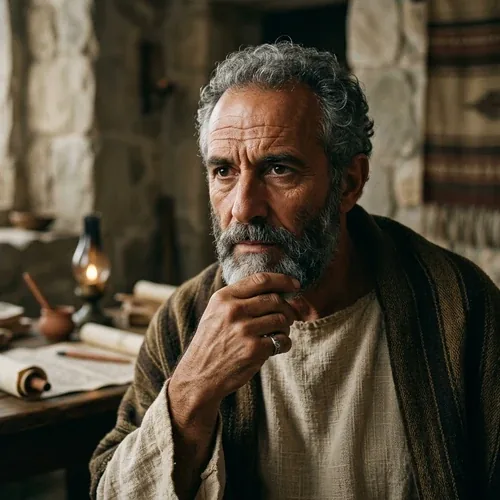
“Christian apostle and missionary (c. 5 – c. 64/65)”
Paul, commonly known as Paul the Apostle or Saint Paul, was a Christian apostle who spread the teachings of Jesus in the first century AD. For his contributions towards the New Testament, he is generally regarded as one of the most important figures of the Apostolic Age, and he also founded several Christian communities in Asia Minor and Europe from the mid-40s to the mid-50s AD.
The early Jesus movement was an exclusively Jewish sect concentrated in Jerusalem and Galilee, adhering strictly to the Temple, ritual circumcision, and food laws, with virtually no mechanism to incorporate Gentile believers without full conversion to Judaism.
Following his Damascus road revelation, Paul championed the revolutionary stance that Gentiles enter the covenant of Abraham through faith in Christ without undergoing physical circumcision or adopting the ceremonial Torah code, founding multi-ethnic churches across Asia Minor and Greece.
Transformed a local Jewish messianic movement into a global world religion, composed nearly one-third of the New Testament, and articulated the theological categories of grace, justification by faith, and universal human conscience that defined Western civilization.
Universal brotherhood in Christ: "There is no longer Jew or Greek, there is no longer slave or free, there is no longer male and female."
Tracing the downstream transmission from Paul the Apostle’s initial intervention through immediate adapters, institutionalization, and enduring consequences in human history.
Following his Damascus road revelation, Paul championed the revolutionary stance that Gentiles enter the covenant of Abraham through faith in Christ without undergoing physical circumcision or adopting the ceremonial Torah code, founding multi-ethnic churches across Asia Minor and Greece.
Rulings, codes, and hermeneutic principles incorporated into yeshiva curricula and communal adjudication.
Commentaries, codes, and responsa accepted as authoritative standards by Diaspora communities.
Paul was educated at the feet of Gamaliel in Pharisaic law.
Theological and revelatory foundation of Paul’s apostolic mission.
Under editorial review.
Without Paul, the Jesus movement would likely have remained an insular Second Temple Jewish sect that dissolved after the Roman destruction of Jerusalem in 70 CE, preventing the spread of biblical ethics to the Greco-Roman world.
How many people, institutions, societies, or disciplines were affected?
Paul the Apostle: Situates Paul’s thought firmly within contemporary Pharisaic hermeneutics, midrashic techniques, and apocalyptic expectations.
Paul the Apostle: Comprehensive historical-critical commentary detailing Paul’s synthesis of Jewish covenantal theology with Greco-Roman rhetorical form.
[Galatians 3:26–29] Universal brotherhood in Christ: "There is no longer Jew or Greek, there is no longer slave or free, there is no longer male and female."
The olive tree metaphor: Gentile believers are wild olive shoots grafted into the rich root of Israel.
Situates Paul’s thought firmly within contemporary Pharisaic hermeneutics, midrashic techniques, and apocalyptic expectations.
Comprehensive historical-critical commentary detailing Paul’s synthesis of Jewish covenantal theology with Greco-Roman rhetorical form.
Integrated into daily liturgy, lifecycle rites, and Jewish constitutional identity worldwide.
Transformed a local Jewish messianic movement into a global world religion, composed nearly one-third of the New Testament, and articulated the theological categories of grace, justification by faith, and universal human conscience that defined Western civilization.
How fundamentally did they alter the structural state of the field or world?
Did the consequences endure decades, centuries, or millennia?
Did they introduce a genuinely new paradigm vs. incremental refinement?
Would this change have happened without this specific individual?
How crucial to Jewish civilization, Torah, ethics, or Israel?
Comprehensive multi-dimensional evaluation of civilizational reach, conceptual depth, duration of legacy, and historical causation across Jewish and world history.
[Romans 11:13–24] The olive tree metaphor: Gentile believers are wild olive shoots grafted into the rich root of Israel.