1K
Loading Reference Work…
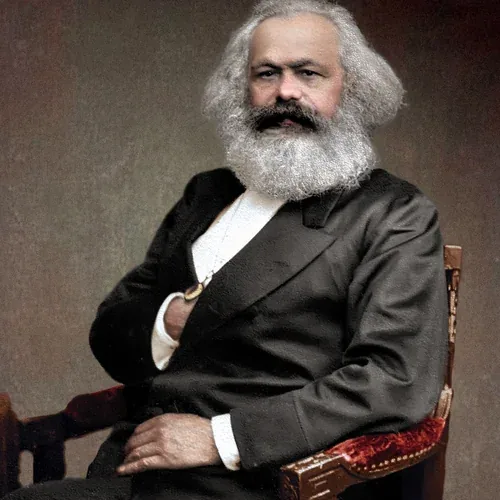
“The philosopher, political economist, and social theorist whose critique of capitalism and theory of historical materialism transformed global politics, economics, and history in the 19th and 20th centuries.”
Karl Marx (1818–1883) was a German philosopher, political economist, and revolutionary socialist. Born into a distinguished rabbinic family in Trier, Marx was baptized in childhood by his secularized father. Co-authoring The Communist Manifesto (1848) with Friedrich Engels and writing Das Kapital (1867), Marx argued that human societies develop through dialectical class struggle between the bourgeoisie and the proletariat. His ideas inspired major revolutions, reshaped global geopolitics, gave birth to modern labor laws, and led to the establishment of communist regimes across one-third of the globe.
Social and political theory explained historical development through political decrees, religious ideals, or Hegelian spiritual dialectics, largely detached from material modes of production.
Formulated historical materialism and scientific critique of capitalism, identifying class struggle and capital accumulation as the primary engines driving human societal evolution.
Transformed global geopolitics, sociology, labor rights, macroeconomics, and philosophy, providing the ideological foundation for major revolutions and social democratic welfare states across the 20th and 21st centuries.
Tracing the downstream transmission from Karl Marx’s initial intervention through immediate adapters, institutionalization, and enduring consequences in human history.
Formulated historical materialism and scientific critique of capitalism, identifying class struggle and capital accumulation as the primary engines driving human societal evolution.
Organized geopolitical congresses, petitions, and financial instruments establishing modern state infrastructure.
Catalyzed mass demographic return, infrastructure development, and institutional state foundations in Eretz Yisrael.
Demonstrated that human societies and their cultural/legal superstructures are determined by their material economic base.
Explicated the mechanism by which capital extracts surplus labor value from the working class.
Co-authored with Engels, synthesized human history as the history of class struggles.
Comprehensive economic critique of the capitalist mode of production and surplus value extraction.
Primary foundational figure.
Benjamin synthesized historical materialism with Jewish messianic theology in his Arcades Project.
Methodological Standard: Jewish identity is strictly documented and never inferred from surnames, physical appearance, geography, or stereotypes. Every profile separates identity claims from verified sources.
Born to Jewish parents Heinrich Marx and Henriette Pressburg, both descended from long lines of prominent rabbis; baptized Lutheran at age six.
Paternal line traced to the rabbinic families of Trier and Lwów; maternal grandfather was a Dutch rabbi. Self-identified as a materialist and secular atheist.
Without Marx, modern sociological analysis of class dynamics, commodity fetishism, and organized labor movements would have developed without their defining theoretical polemic.
How many people, institutions, societies, or disciplines were affected?
Marx co-authored The Communist Manifesto with Friedrich Engels in London in February 1848.
Marx’s maternal grandfather, Isaac Heymans Pressburg, was chief rabbi of Nijmegen.
Contextualizes Marx’s rabbinic ancestry, Trier childhood, and European revolutionary economic writings.
Safeguarded Jewish collective survival and sovereign refuge following millennia of exile and dispersion.
Transformed global geopolitics, sociology, labor rights, macroeconomics, and philosophy, providing the ideological foundation for major revolutions and social democratic welfare states across the 20th and 21st centuries.
How fundamentally did they alter the structural state of the field or world?
Did the consequences endure decades, centuries, or millennia?
Did they introduce a genuinely new paradigm vs. incremental refinement?
Would this change have happened without this specific individual?
How crucial to Jewish civilization, Torah, ethics, or Israel?
Vast, world-transforming political, intellectual, and economic consequences across all continents in the modern era.