1K
Loading Reference Work…
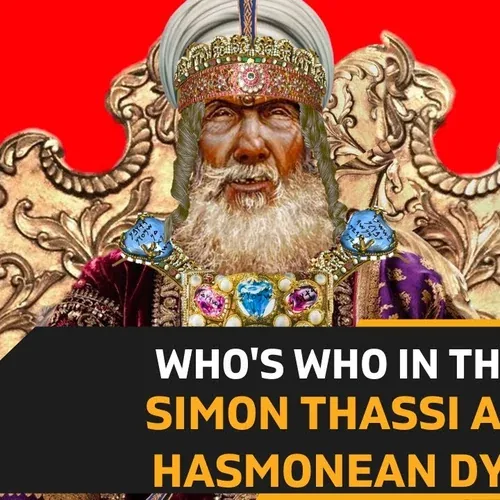
“High Priest of Israel, founder of the Hasmonean dynasty”
Simon Thassi was a Jewish leader of the Hasmonean dynasty, serving as high priest, military commander, and ruler of Judea. The second son of the Hasmonean patriarch Mattathias and one of the Maccabean brothers, he assumed leadership after his brother Jonathan Apphus was captured by the Seleucid general Diodotus Tryphon. Simon played a central role in consolidating Hasmonean rule: he strengthened Judea's fortifications, expelled the Seleucid garrison from Jerusalem, and expanded Jewish settlement, laying the foundation for the Hasmonean state. His rule marked the beginning of effective Jewish independence.
Judea remained nominally subject to Seleucid tribute, with a hostile Syrian garrison still occupying the Akra citadel in the heart of Jerusalem overlooking the Temple.
Simon captured the coastal port of Joppa, starved out and demolished the Akra citadel, negotiated total exemption from Seleucid taxes, and was ratified by a Great Assembly of Jews as Prince (*Nasi*) and High Priest in perpetuity.
Achieved complete political and economic independence for Judea in 142 BCE, inaugurating a golden era of tranquility ("every man sat under his vine and fig tree") and establishing the independent Hasmonean Commonwealth.
Eulogy for Simon’s peaceful reign: "The land was quiet all the days of Simon... each sat under his own vine and fig tree, and there was no one to make them afraid."
Tracing the downstream transmission from Simon Thassi’s initial intervention through immediate adapters, institutionalization, and enduring consequences in human history.
Simon captured the coastal port of Joppa, starved out and demolished the Akra citadel, negotiated total exemption from Seleucid taxes, and was ratified by a Great Assembly of Jews as Prince (*Nasi*) and High Priest in perpetuity.
Rulings, codes, and hermeneutic principles incorporated into yeshiva curricula and communal adjudication.
Commentaries, codes, and responsa accepted as authoritative standards by Diaspora communities.
Without Simon’s elimination of the Akra garrison and tax emancipation, Judean autonomy would have remained precarious and vulnerable to sudden Seleucid re-conquest.
How many people, institutions, societies, or disciplines were affected?
Simon Thassi: Details the constitutional decree of 140 BCE inscribed on bronze tablets on Mount Zion confirming Simon’s dynastic legitimacy.
[1 Maccabees 14:4–15] Eulogy for Simon’s peaceful reign: "The land was quiet all the days of Simon... each sat under his own vine and fig tree, and there was no one to make them afraid."
Details the constitutional decree of 140 BCE inscribed on bronze tablets on Mount Zion confirming Simon’s dynastic legitimacy.
Integrated into daily liturgy, lifecycle rites, and Jewish constitutional identity worldwide.
Achieved complete political and economic independence for Judea in 142 BCE, inaugurating a golden era of tranquility ("every man sat under his vine and fig tree") and establishing the independent Hasmonean Commonwealth.
How fundamentally did they alter the structural state of the field or world?
Did the consequences endure decades, centuries, or millennia?
Did they introduce a genuinely new paradigm vs. incremental refinement?
Would this change have happened without this specific individual?
How crucial to Jewish civilization, Torah, ethics, or Israel?
Comprehensive multi-dimensional evaluation of civilizational reach, conceptual depth, duration of legacy, and historical causation across Jewish and world history.