1K
Loading Reference Work…
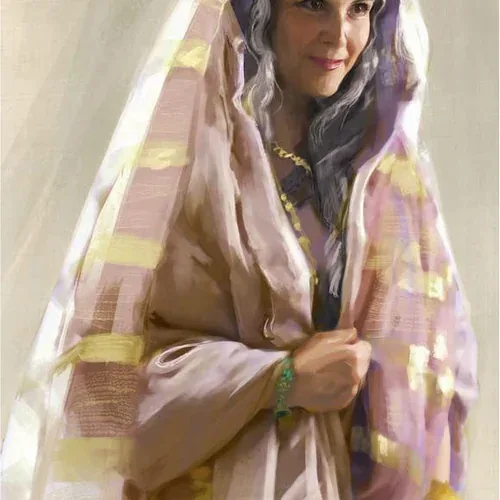
“Biblical matriarch”
Sarah is a biblical matriarch, prophet, and major figure in Abrahamic religions. While different Abrahamic faiths portray her differently, Judaism, Christianity, and Islam all depict her character similarly, as that of a pious woman, renowned for her hospitality and beauty, the wife of Abraham, and the mother of Isaac. Sarah has her feast day on 1 September in the Catholic Church, 19 August in the Coptic Orthodox Church, 20 January in the LCMS, and 12 and 20 December in the Eastern Orthodox Church.
Women in the ancient Near East had no independent status in sacred clan covenants, while barrenness was viewed as divine rejection and grounds for permanent marital displacement.
Sarah partnered with Abraham in the migration to Canaan, welcomed guests with radical hospitality, endured decades of barrenness before giving birth to Isaac in extreme old age, and fiercely protected Isaac’s exclusive spiritual succession as the sole covenantal heir.
Stands as the inaugural Matriarch of the Jewish people, venerated as the mother of the covenant in both biblical literature and prophetic memory ("Look to Abraham your father and to Sarah who bore you").
Tracing the downstream transmission from Sarah’s initial intervention through immediate adapters, institutionalization, and enduring consequences in human history.
Sarah partnered with Abraham in the migration to Canaan, welcomed guests with radical hospitality, endured decades of barrenness before giving birth to Isaac in extreme old age, and fiercely protected Isaac’s exclusive spiritual succession as the sole covenantal heir.
Rulings, codes, and hermeneutic principles incorporated into yeshiva curricula and communal adjudication.
Commentaries, codes, and responsa accepted as authoritative standards by Diaspora communities.
Had Sarah not insisted on Isaac’s sole inheritance over Ishmael, the Abrahamic mission would have dispersed into competing desert tribes rather than producing a dedicated covenant community.
How many people, institutions, societies, or disciplines were affected?
Sarah: Highlights Sarah’s decisive theological role where God explicitly commands Abraham to obey her voice concerning covenantal succession.
[Genesis 21:1–12] The birth of Isaac and God’s instruction to Abraham: "Listen to all that Sarah tells you."
[Isaiah 51:1–2] Prophetic exhortation to remember roots: "Look to Abraham your father, and to Sarah who bore you."
The birth of Isaac and God’s instruction to Abraham: "Listen to all that Sarah tells you."
Prophetic exhortation to remember roots: "Look to Abraham your father, and to Sarah who bore you."
Highlights Sarah’s decisive theological role where God explicitly commands Abraham to obey her voice concerning covenantal succession.
Integrated into daily liturgy, lifecycle rites, and Jewish constitutional identity worldwide.
Stands as the inaugural Matriarch of the Jewish people, venerated as the mother of the covenant in both biblical literature and prophetic memory ("Look to Abraham your father and to Sarah who bore you").
How fundamentally did they alter the structural state of the field or world?
Did the consequences endure decades, centuries, or millennia?
Did they introduce a genuinely new paradigm vs. incremental refinement?
Would this change have happened without this specific individual?
How crucial to Jewish civilization, Torah, ethics, or Israel?
Comprehensive multi-dimensional evaluation of civilizational reach, conceptual depth, duration of legacy, and historical causation across Jewish and world history.