1K
Loading Reference Work…
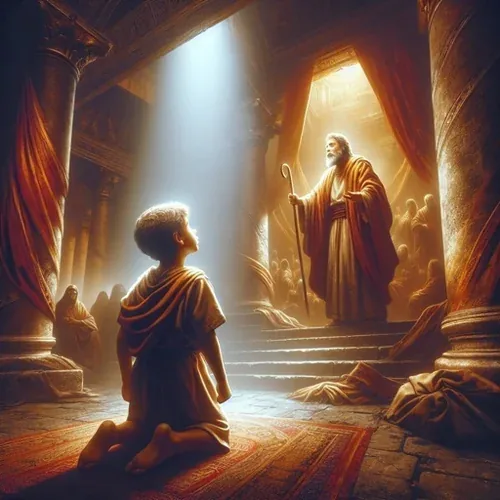
“Biblical prophet and seer”
Samuel is a figure who, in the narratives of the Hebrew Bible, plays a key role in the transition from the biblical judges to the United Kingdom of Israel under Saul, and again in the monarchy's transition from Saul to David. He is venerated as a prophet in Judaism, Christianity, and Islam. In addition to his role in the Jewish Bible/Old Testament, Samuel is mentioned in Jewish rabbinical literature, in the Christian New Testament, and in the second chapter of the Quran. He is also treated in the fifth through seventh books of Antiquities of the Jews, written by the Jewish scholar Josephus in the first century. He is first called "the Seer" in 1 Samuel 9:9.
Israel was plagued by political anarchy ("everyone did what was right in his own eyes"), corrupt sanctuary leadership under the sons of Eli at Shiloh, and the catastrophic loss of the Ark of the Covenant to the Philistines.
Dedicated to God from birth by Hannah, Samuel established circuit courts of upright judicial administration, reawakened prophetic leadership, and faithfully navigated the perilous transition to statehood by anointing both Saul and David.
Unified the spiritual and political institutions of Israel, established the prophetic role as the independent moral check on royal power, and laid the foundations for the United Monarchy.
Tracing the downstream transmission from Samuel’s initial intervention through immediate adapters, institutionalization, and enduring consequences in human history.
Dedicated to God from birth by Hannah, Samuel established circuit courts of upright judicial administration, reawakened prophetic leadership, and faithfully navigated the perilous transition to statehood by anointing both Saul and David.
Rulings, codes, and hermeneutic principles incorporated into yeshiva curricula and communal adjudication.
Commentaries, codes, and responsa accepted as authoritative standards by Diaspora communities.
Primary foundational figure.
Prophetic anointing of Israel’s first monarch.
Anointed David as enduring king of Israel in Bethlehem.
Without Samuel, the transition to monarchy would either have dissolved into pagan despotism without moral accountability, or the tribes would have been completely conquered by the Philistines.
How many people, institutions, societies, or disciplines were affected?
Samuel: Explores Samuel’s dual role as the last judge and first major classical prophet who established the constitutional limits of the Israelite crown.
[1 Samuel 3:1–21] The call of the child Samuel in the sanctuary of Shiloh: "Speak, for your servant is listening."
[1 Samuel 15:22–23] Prophetic rebuke of Saul: "To obey is better than sacrifice, and to heed than the fat of rams."
The call of the child Samuel in the sanctuary of Shiloh: "Speak, for your servant is listening."
Prophetic rebuke of Saul: "To obey is better than sacrifice, and to heed than the fat of rams."
Explores Samuel’s dual role as the last judge and first major classical prophet who established the constitutional limits of the Israelite crown.
Integrated into daily liturgy, lifecycle rites, and Jewish constitutional identity worldwide.
Unified the spiritual and political institutions of Israel, established the prophetic role as the independent moral check on royal power, and laid the foundations for the United Monarchy.
How fundamentally did they alter the structural state of the field or world?
Did the consequences endure decades, centuries, or millennia?
Did they introduce a genuinely new paradigm vs. incremental refinement?
Would this change have happened without this specific individual?
How crucial to Jewish civilization, Torah, ethics, or Israel?
Comprehensive multi-dimensional evaluation of civilizational reach, conceptual depth, duration of legacy, and historical causation across Jewish and world history.