1K
Loading Reference Work…
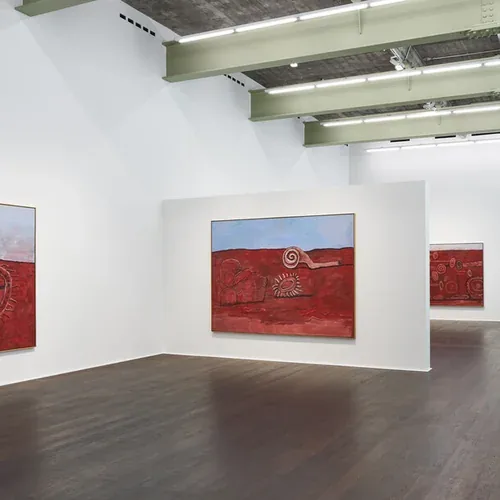
“Canadian-American painter and printmaker (1913–1980)”
Philip Guston was a Canadian and American painter, printmaker, muralist and draftsman. "Guston worked in a number of artistic modes, from Renaissance-inspired figuration to formally accomplished abstraction," and is now regarded as one of the "most important, powerful, and influential American painters of the last 100 years". He frequently depicted racism, antisemitism, fascism and American identity, as well as—especially in his later most cartoonish and mocking work—the banality of evil. In 2013, Guston's painting To Fellini set an auction record at Christie's when it sold for US$25.8 million.
Practices and discourse in Visual Art, Architecture & Design were shaped by prevailing generational conventions and historical constraints.
Delivered innovative leadership, foundational insights, or creative works that permanently altered the frontier of Visual Art, Architecture & Design.
Established precedents, standards of excellence, and cultural milestones that endure in contemporary society.
Tracing the downstream transmission from Philip Guston’s initial intervention through immediate adapters, institutionalization, and enduring consequences in human history.
Delivered innovative leadership, foundational insights, or creative works that permanently altered the frontier of Visual Art, Architecture & Design.
Published treatises and dialectic essays debated across academies, courts, and international peer networks.
Adopted by subsequent generations of thinkers, writers, and artists who built directly upon these foundational concepts.
Without their decisive contributions, the historical development of Visual Art, Architecture & Design would have unfolded along a more diminished trajectory.
How many people, institutions, societies, or disciplines were affected?
Incorporated into the permanent canon of human civilization, political philosophy, or world literature.
Established precedents, standards of excellence, and cultural milestones that endure in contemporary society.
How fundamentally did they alter the structural state of the field or world?
Did the consequences endure decades, centuries, or millennia?
Did they introduce a genuinely new paradigm vs. incremental refinement?
Would this change have happened without this specific individual?
How crucial to Jewish civilization, Torah, ethics, or Israel?
Comprehensive multi-dimensional evaluation of civilizational reach, conceptual depth, duration of legacy, and historical causation across Jewish and world history.