1K
Loading Reference Work…
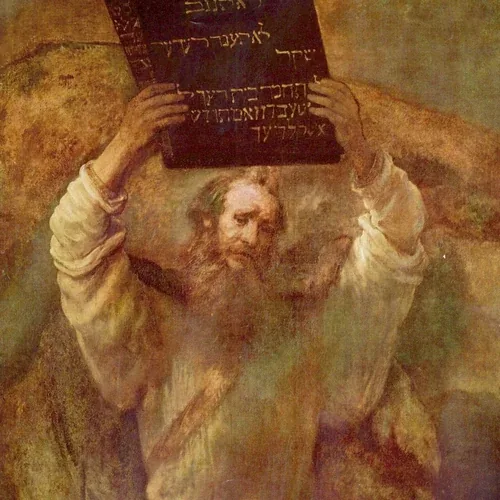
“The lawgiver who transformed an enslaved rabble into a covenantal nation, establishing ethical monotheism and the moral architecture of Western law.”
Moses is the preeminent prophet, lawgiver, and teacher of Judaism. According to the scriptural account and millennia of civilizational transmission, Moses led the Israelites out of Egyptian bondage, mediated the covenant at Mount Sinai, communicated the Torah, and guided the nascent nation through forty years in the wilderness. The legal, ethical, and constitutional principles transmitted in the Five Books of Moses became the bedrock not only of rabbinic Judaism, but of Christianity, Islam, and the human rights tradition.
Human civilization was dominated by polytheistic imperial pantheons where monarchs were living gods, morality was arbitrary, justice was stratified by caste, and human life held no intrinsic sacred dignity.
Moses introduced ethical monotheism, declaring God as universal, righteous, and beyond physical representation, and enacted a constitutional legal covenant that subordinated kings to moral law and sanctified every human being as created in the divine image.
The Mosaic covenant established the weekly Sabbath (universal rest for all humans and animals), statutory justice, protection for the stranger, widow, and orphan, and laid the direct moral foundation for Western constitutional democracy.
Tracing the downstream transmission from Moses’s initial intervention through immediate adapters, institutionalization, and enduring consequences in human history.
Moses introduced ethical monotheism, declaring God as universal, righteous, and beyond physical representation, and enacted a constitutional legal covenant that subordinated kings to moral law and sanctified every human being as created in the divine image.
Rulings, codes, and hermeneutic principles incorporated into yeshiva curricula and communal adjudication.
Commentaries, codes, and responsa accepted as authoritative standards by Diaspora communities.
Introduced absolute ethical standards: prohibition of idolatry, murder, theft, and false witness, alongside universal Sabbath rest.
Authored/transmitted the founding constitutional document of Jewish civilization and the moral heritage of humanity.
Forged twelve disparate tribes of former slaves into a self-governing nation governed by statutory law.
Primary foundational figure.
Maimonides named his code Mishneh Torah after the Mosaic code; epitaph: "From Moses to Moses, none arose like Moses."
Ben-Gurion viewed modern Israel as the fulfillment of the biblical return led by Moses and Joshua, instituting the Bible study circle.
Co-leadership of the Exodus: prophet and high priest.
Formal transmission of authority: Moses placed his hands on Joshua.
Methodological Standard: Jewish identity is strictly documented and never inferred from surnames, physical appearance, geography, or stereotypes. Every profile separates identity claims from verified sources.
Foundational prophet and covenantal lawgiver of the Israelite nation.
Derived from biblical scriptural text and universal Jewish tradition as the son of Amram and Jochebed of the Tribe of Levi.
Without Moses, the Hebrew tribes would have perished in Egyptian chattel slavery, ethical monotheism would have lacked a legal constitution, and concepts of equal human dignity under statutory law would never have emerged.
How many people, institutions, societies, or disciplines were affected?
Moses transmitted the Decalogue and the Torah to the Israelite nation at Mount Sinai.
The Mosaic Sabbath introduced the first statutory universal day of rest in human history.
Moses: Examines Moses as the supreme prophet, lawgiver, and intercessor who uniquely spoke with God "face to face" (Exod 33:11; Deut 34:10).
The Decalogue (Ten Commandments) delivered at Mount Sinai: foundational constitutional law of ethical monotheism.
The Shema: declaration of the unity of God and the perpetual mandate to love God with heart, soul, and might.
Examines Moses as the supreme prophet, lawgiver, and intercessor who uniquely spoke with God "face to face" (Exod 33:11; Deut 34:10).
Details how the Sinai covenant revolutionized ancient Near Eastern legal traditions by establishing covenantal obligations between God and an entire people.
Integrated into daily liturgy, lifecycle rites, and Jewish constitutional identity worldwide.
The Mosaic covenant established the weekly Sabbath (universal rest for all humans and animals), statutory justice, protection for the stranger, widow, and orphan, and laid the direct moral foundation for Western constitutional democracy.
How fundamentally did they alter the structural state of the field or world?
Did the consequences endure decades, centuries, or millennia?
Did they introduce a genuinely new paradigm vs. incremental refinement?
Would this change have happened without this specific individual?
How crucial to Jewish civilization, Torah, ethics, or Israel?
Unsurpassed civilizational duration (3,300+ years), foundational causality for three world faiths, and universal legal impact.
Moses: Details how the Sinai covenant revolutionized ancient Near Eastern legal traditions by establishing covenantal obligations between God and an entire people.
[Exodus 20:1–17] The Decalogue (Ten Commandments) delivered at Mount Sinai: foundational constitutional law of ethical monotheism.
[Deuteronomy 6:4–9] The Shema: declaration of the unity of God and the perpetual mandate to love God with heart, soul, and might.