1K
Loading Reference Work…
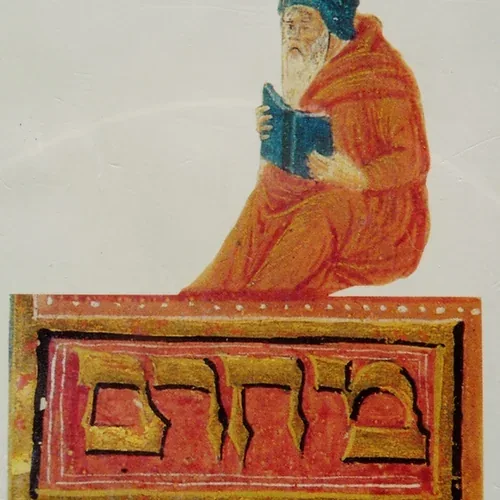
“German rabbi and poet (c.1215–1293)”
Meir of Rothenburg (c. 1215 – 2 May 1293) was a German Rabbi and poet, as well as a major contributing author of the tosafot on Rashi's commentary on the Talmud. He is also known as Meir ben Baruch, and by the Hebrew language acronym Maharam of Rothenburg. He was referred to by Rabbi Menachem Meiri as the "greatest Jewish leader of Zarfat" alive at the time.
Communal law and scriptural interpretation faced dispersion following the destruction of ancient academies and geographic exile.
Authored authoritative codices, responsa, or commentaries that unified and preserved Jewish communal life across centuries.
Their rulings and scholarship are studied daily in yeshivot, academies, and communal forums across the globe.
Tracing the downstream transmission from Meir of Rothenburg’s initial intervention through immediate adapters, institutionalization, and enduring consequences in human history.
Authored authoritative codices, responsa, or commentaries that unified and preserved Jewish communal life across centuries.
Rulings, codes, and hermeneutic principles incorporated into yeshiva curricula and communal adjudication.
Commentaries, codes, and responsa accepted as authoritative standards by Diaspora communities.
Without their definitive legal guidance, historical Jewish communal cohesion through centuries of dispersal would have fractured.
How many people, institutions, societies, or disciplines were affected?
Integrated into daily liturgy, lifecycle rites, and Jewish constitutional identity worldwide.
Their rulings and scholarship are studied daily in yeshivot, academies, and communal forums across the globe.
How fundamentally did they alter the structural state of the field or world?
Did the consequences endure decades, centuries, or millennia?
Did they introduce a genuinely new paradigm vs. incremental refinement?
Would this change have happened without this specific individual?
How crucial to Jewish civilization, Torah, ethics, or Israel?
Comprehensive multi-dimensional evaluation of civilizational reach, conceptual depth, duration of legacy, and historical causation across Jewish and world history.