1K
Loading Reference Work…
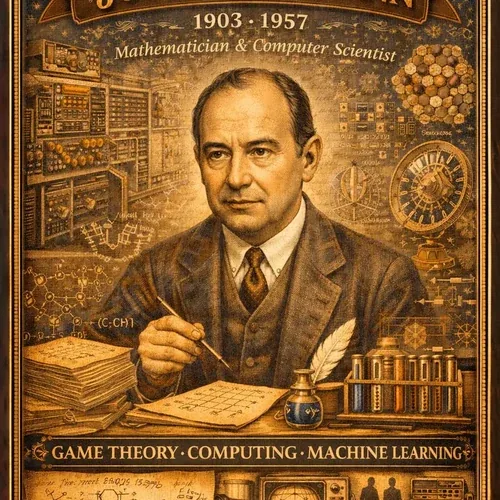
“The universal mathematical polymath who designed modern computer architecture, founded game theory, axiomatized quantum mechanics, and engineered the digital age.”
John von Neumann (1903–1957) was a Hungarian-American mathematician, physicist, and polymath whose intellect was regarded by peers as superhuman. Von Neumann formulated the mathematical foundations of quantum mechanics, invented game theory (revolutionizing modern economics and geopolitics), designed the "von Neumann architecture" that powers virtually every computer, smartphone, and microprocessor in existence, and served as a vital leader of the Manhattan Project.
Computing machines were fixed-function electronic calculators, economic strategic conflict lacked formal mathematical proof, and quantum mechanics was missing a unified Hilbert space axiomatic foundation.
Invented the stored-program computer architecture (von Neumann architecture), founded mathematical game theory, established the mathematical axioms of quantum mechanics, and pioneered cellular automata.
Virtually all modern digital computing devices, microprocessors, economics decision models, nuclear physics simulations, and modern numerical analysis trace directly to his intellect.
Tracing the downstream transmission from John von Neumann’s initial intervention through immediate adapters, institutionalization, and enduring consequences in human history.
Invented the stored-program computer architecture (von Neumann architecture), founded mathematical game theory, established the mathematical axioms of quantum mechanics, and pioneered cellular automata.
Hypotheses subjected to empirical testing, mathematical formulation, and international peer replication during the Modern Period, 1880–1945.
Formulations integrated into university curricula, national laboratories, and engineering applications.
Established the stored-program concept where instructions and data share the same memory space.
Proved the minimax theorem for zero-sum games, creating the mathematics of modern strategic economics.
Axiomatized quantum mechanics using operator theory on Hilbert spaces.
Co-authored with Oskar Morgenstern, founded mathematical game theory and strategic decision analysis.
Described the universal architecture of modern computing (CPU, memory, bus, input/output).
Colleagues at the Institute for Advanced Study in Princeton during the dawn of the nuclear and computational era.
Founded cybernetics and automated feedback systems bridging mathematics and neurology.
Pioneered computational simulations and quantum electrodynamics at Los Alamos.
Methodological Standard: Jewish identity is strictly documented and never inferred from surnames, physical appearance, geography, or stereotypes. Every profile separates identity claims from verified sources.
Born János Lajos Neumann in Budapest to non-observant Jewish parents Miksa Neumann and Margit Kann.
Secular Jewish background; baptized Catholic in 1930 for marriage purposes, but identified culturally and historically with Jewish intellectual community throughout life.
Without von Neumann, modern electronic computer design would have fractured into non-programmable architectures, delaying the digital age and computational sciences by decades.
How many people, institutions, societies, or disciplines were affected?
Von Neumann authored the "First Draft of a Report on the EDVAC" in 1945, establishing the stored-program computer.
Von Neumann served on the Scientific Advisory Committee to the Atomic Energy Commission until his death.
Examines von Neumann’s polymathic breakthroughs across quantum theory, computing, game theory, and the Manhattan Project.
Translated into widespread clinical therapies, computational architectures, or industrial technologies preserving human life.
Virtually all modern digital computing devices, microprocessors, economics decision models, nuclear physics simulations, and modern numerical analysis trace directly to his intellect.
How fundamentally did they alter the structural state of the field or world?
Did the consequences endure decades, centuries, or millennia?
Did they introduce a genuinely new paradigm vs. incremental refinement?
Would this change have happened without this specific individual?
How crucial to Jewish civilization, Torah, ethics, or Israel?
The universal intellectual engine behind the modern computer and digital economy, possessing unmatched multi-disciplinary breadth.