1K
Loading Reference Work…
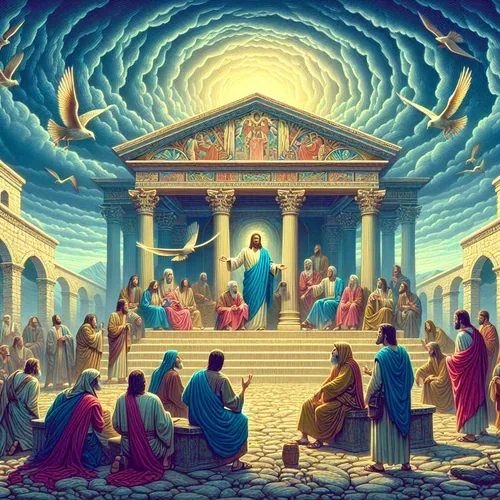
“Prophet (6 BC – AD 30)”
John the Baptist was a religious preacher active in the area of the Jordan River in the early first century AD. He is also known as Saint John the Forerunner in Eastern Orthodoxy, Eastern Catholicism, and Oriental Orthodoxy, Saint John the Immerser in the Baptist tradition, and as the prophet Yahya ibn Zakariya in Islam. He is sometimes referred to as John the Baptiser.
First-century Judean society was simmering with moral despair under Herodian corruption and Roman occupation, while ritual bathing (*mikveh*) was largely restricted to ceremonial purity rather than radical moral conversion.
Dwelling as an ascetic in the Judean wilderness, John preached urgent repentance in view of the imminent Kingdom of God, instituted an open baptism of moral renewal in the Jordan River, and baptized Jesus of Nazareth.
Ignited the widespread revival movement that prepared the way for the Galilean ministry of Jesus, established baptism as the universal initiatory rite of Christianity, and was martyred for speaking truth to tyrannical power.
John’s preaching in the Jordan wilderness: "Produce fruits worthy of repentance" and ethical demands on soldiers and tax collectors.
Tracing the downstream transmission from John the Baptist’s initial intervention through immediate adapters, institutionalization, and enduring consequences in human history.
Dwelling as an ascetic in the Judean wilderness, John preached urgent repentance in view of the imminent Kingdom of God, instituted an open baptism of moral renewal in the Jordan River, and baptized Jesus of Nazareth.
Rulings, codes, and hermeneutic principles incorporated into yeshiva curricula and communal adjudication.
Commentaries, codes, and responsa accepted as authoritative standards by Diaspora communities.
Without John’s catalytic wilderness revival, the messianic expectations in Judea and Galilee would have lacked the moral momentum that propelled Jesus’s public ministry into national prominence.
How many people, institutions, societies, or disciplines were affected?
John the Baptist: Compares John’s ascetic immersion theology with contemporary Essene practices at Qumran and Josephus’s account in Antiquities 18.
[Luke 3:2–18] John’s preaching in the Jordan wilderness: "Produce fruits worthy of repentance" and ethical demands on soldiers and tax collectors.
[Matthew 3:13–17] The baptism of Jesus by John in the Jordan River and the descent of the Holy Spirit.
The baptism of Jesus by John in the Jordan River and the descent of the Holy Spirit.
Compares John’s ascetic immersion theology with contemporary Essene practices at Qumran and Josephus’s account in Antiquities 18.
Integrated into daily liturgy, lifecycle rites, and Jewish constitutional identity worldwide.
Ignited the widespread revival movement that prepared the way for the Galilean ministry of Jesus, established baptism as the universal initiatory rite of Christianity, and was martyred for speaking truth to tyrannical power.
How fundamentally did they alter the structural state of the field or world?
Did the consequences endure decades, centuries, or millennia?
Did they introduce a genuinely new paradigm vs. incremental refinement?
Would this change have happened without this specific individual?
How crucial to Jewish civilization, Torah, ethics, or Israel?
Comprehensive multi-dimensional evaluation of civilizational reach, conceptual depth, duration of legacy, and historical causation across Jewish and world history.