1K
Loading Reference Work…
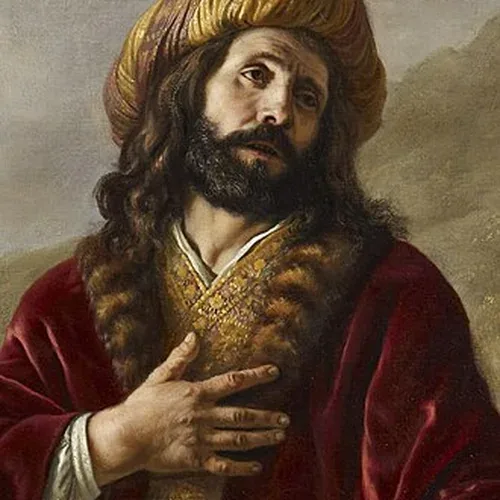
“Biblical patriarch, son of Isaac”
Jacob, later given the name Israel, is the third Hebrew patriarch in Judaism and an important figure in the Abrahamic religions. He first appears in the Torah, where he is described in the Book of Genesis as a son of Isaac and Rebecca. Accordingly, alongside his older fraternal twin brother Esau, Jacob's paternal grandparents are Abraham and Sarah and his maternal grandfather is Bethuel, whose wife is not mentioned. He is said to have bought Esau's birthright and, with his mother's help, deceived his aging father to bless him instead of Esau. Then, following a severe drought in his homeland Canaan, Jacob and his descendants migrated to neighbouring Egypt through the efforts of his son Joseph, who had become a confidant of the pharaoh. After dying in Egypt at the age of 147, he is supposed to have been buried in the Cave of Machpelah in Hebron.
The covenant was held by individual patriarchs (Abraham, Isaac) with only a single chosen heir, while non-chosen brothers (Ishmael, Esau) departed from the spiritual mission.
Jacob fathered twelve sons across Leah, Rachel, Bilhah, and Zilpah, wrestled through the night with a divine messenger at Peniel to emerge with the name *Israel* ("one who strives with God and humans and prevails"), and sanctified all twelve sons as equal heirs of the covenant.
Transformed the family covenant into a national reality (*Bnei Yisrael* / The Children of Israel), establishing the tribal architecture of the Jewish people and the defining motif of spiritual struggle, resilience, and transformation.
Tracing the downstream transmission from Jacob’s initial intervention through immediate adapters, institutionalization, and enduring consequences in human history.
Jacob fathered twelve sons across Leah, Rachel, Bilhah, and Zilpah, wrestled through the night with a divine messenger at Peniel to emerge with the name *Israel* ("one who strives with God and humans and prevails"), and sanctified all twelve sons as equal heirs of the covenant.
Rulings, codes, and hermeneutic principles incorporated into yeshiva curricula and communal adjudication.
Commentaries, codes, and responsa accepted as authoritative standards by Diaspora communities.
Patriarchal covenantal blessing and spiritual succession.
Favor and foundational tribal leadership transmitted before Egyptian descent.
Without Jacob, the covenantal promise would have remained an elite lineage rather than coalescing into the twelve-tribed commonwealth of Israel that stood at Mount Sinai.
How many people, institutions, societies, or disciplines were affected?
Jacob: Examines Jacob’s moral and spiritual maturation from deceptive youth to suffering, righteous father of the twelve tribes.
[Genesis 28:10–22] Jacob’s dream at Bethel: the vision of the ladder between earth and heaven with angels ascending and descending.
[Genesis 32:24–32] Jacob wrestles at the Jabbok ford and is given the name Israel: "for you have striven with beings divine and human, and have prevailed."
Jacob’s dream at Bethel: the vision of the ladder between earth and heaven with angels ascending and descending.
Jacob wrestles at the Jabbok ford and is given the name Israel: "for you have striven with beings divine and human, and have prevailed."
Examines Jacob’s moral and spiritual maturation from deceptive youth to suffering, righteous father of the twelve tribes.
Integrated into daily liturgy, lifecycle rites, and Jewish constitutional identity worldwide.
Transformed the family covenant into a national reality (*Bnei Yisrael* / The Children of Israel), establishing the tribal architecture of the Jewish people and the defining motif of spiritual struggle, resilience, and transformation.
How fundamentally did they alter the structural state of the field or world?
Did the consequences endure decades, centuries, or millennia?
Did they introduce a genuinely new paradigm vs. incremental refinement?
Would this change have happened without this specific individual?
How crucial to Jewish civilization, Torah, ethics, or Israel?
Comprehensive multi-dimensional evaluation of civilizational reach, conceptual depth, duration of legacy, and historical causation across Jewish and world history.