1K
Loading Reference Work…
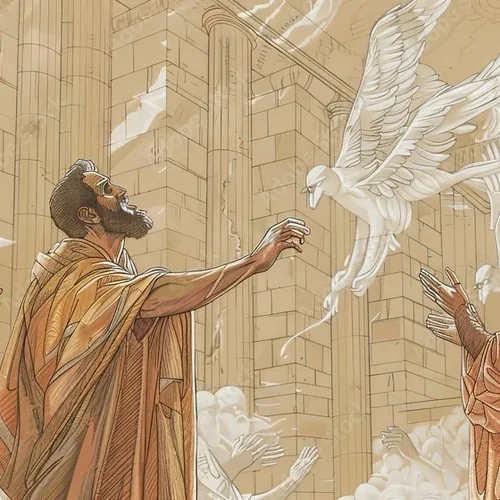
“Israelite prophet”
Isaiah was the 8th-century BC Israelite prophet after whom the Book of Isaiah is named.
Judah was trapped between corrupt aristocratic complacency and the terrifying, steamrolling military expansion of the Neo-Assyrian Empire, oscillating between foreign pagan alliances and ritualistic, hollow temple worship.
Isaiah confronted kings and princes in Jerusalem, summoned the nation to repentance, articulated the vision of God’s absolute holiness ("Holy, holy, holy"), prophesied universal peace among nations, and articulated the comfort and restoration of Zion.
Penned the supreme masterpiece of biblical poetic prophecy, gifted humanity the timeless vision of beating "swords into plowshares," and provided the linguistic and theological vocabulary of Messianic hope for both Judaism and Christianity.
Tracing the downstream transmission from Isaiah’s initial intervention through immediate adapters, institutionalization, and enduring consequences in human history.
Isaiah confronted kings and princes in Jerusalem, summoned the nation to repentance, articulated the vision of God’s absolute holiness ("Holy, holy, holy"), prophesied universal peace among nations, and articulated the comfort and restoration of Zion.
Rulings, codes, and hermeneutic principles incorporated into yeshiva curricula and communal adjudication.
Commentaries, codes, and responsa accepted as authoritative standards by Diaspora communities.
Primary foundational figure.
Prophetic tradition of moral critique, covenantal loyalty, and messianic peace.
Without Isaiah’s counsel during Sennacherib’s siege of Jerusalem in 701 BCE, Judah would have been annihilated a century before the Babylonian exile, wiping out the Davidic line and the prophetic corpus.
How many people, institutions, societies, or disciplines were affected?
Isaiah: Provides comprehensive commentary on First, Second, and Third Isaiah, illuminating the rhetorical power of the prophetic poetry.
[Isaiah 2:2–4] The universal vision of Zion: nations beating their swords into plowshares and learning war no more.
[Isaiah 40:1–11] The message of comfort: "Comfort, O comfort My people, says your God."
The universal vision of Zion: nations beating their swords into plowshares and learning war no more.
The message of comfort: "Comfort, O comfort My people, says your God."
Provides comprehensive commentary on First, Second, and Third Isaiah, illuminating the rhetorical power of the prophetic poetry.
Integrated into daily liturgy, lifecycle rites, and Jewish constitutional identity worldwide.
Penned the supreme masterpiece of biblical poetic prophecy, gifted humanity the timeless vision of beating "swords into plowshares," and provided the linguistic and theological vocabulary of Messianic hope for both Judaism and Christianity.
How fundamentally did they alter the structural state of the field or world?
Did the consequences endure decades, centuries, or millennia?
Did they introduce a genuinely new paradigm vs. incremental refinement?
Would this change have happened without this specific individual?
How crucial to Jewish civilization, Torah, ethics, or Israel?
Comprehensive multi-dimensional evaluation of civilizational reach, conceptual depth, duration of legacy, and historical causation across Jewish and world history.