1K
Loading Reference Work…
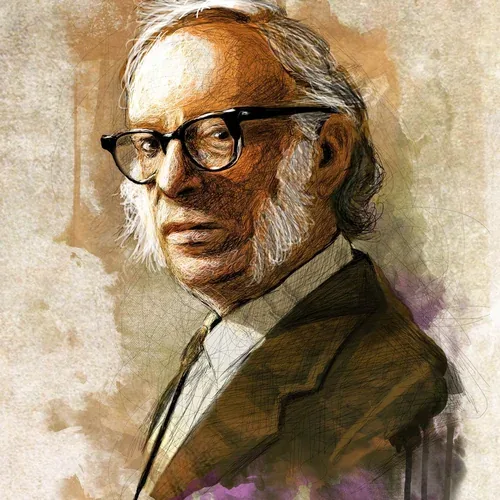
“American writer and biochemist (1920–1992)”
Isaac Asimov was an American writer and professor of biochemistry at Boston University. During his lifetime, Asimov was considered one of the "Big Three" science fiction writers, along with Robert A. Heinlein and Arthur C. Clarke. He wrote or edited more than 500 books and an estimated 90,000 letters and postcards. Best known for his hard science fiction, Asimov also wrote mysteries and fantasy, as well as popular science and other non-fiction. His work spans nine out of the ten categories of the Dewey decimal system.
Literary traditions were constrained by conventional forms, national idioms, and formal narrative structures.
Crafted enduring literary masterpieces that articulated the human condition, memory, and spiritual endurance.
Their literary corpus remains celebrated worldwide as part of the permanent canon of world literature.
Tracing the downstream transmission from Isaac Asimov’s initial intervention through immediate adapters, institutionalization, and enduring consequences in human history.
Crafted enduring literary masterpieces that articulated the human condition, memory, and spiritual endurance.
Published treatises and dialectic essays debated across academies, courts, and international peer networks.
Adopted by subsequent generations of thinkers, writers, and artists who built directly upon these foundational concepts.
Without their distinctive voice, world literature would be deprived of essential reflections on 20th-century human experience.
How many people, institutions, societies, or disciplines were affected?
Incorporated into the permanent canon of human civilization, political philosophy, or world literature.
Their literary corpus remains celebrated worldwide as part of the permanent canon of world literature.
How fundamentally did they alter the structural state of the field or world?
Did the consequences endure decades, centuries, or millennia?
Did they introduce a genuinely new paradigm vs. incremental refinement?
Would this change have happened without this specific individual?
How crucial to Jewish civilization, Torah, ethics, or Israel?
Comprehensive multi-dimensional evaluation of civilizational reach, conceptual depth, duration of legacy, and historical causation across Jewish and world history.