1K
Loading Reference Work…
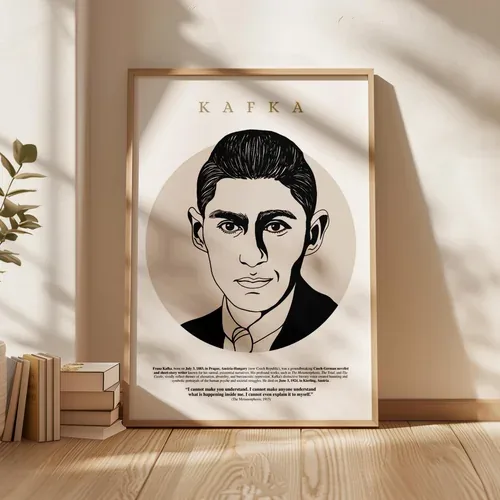
“The literary visionary of modern alienation, bureaucratic tyranny, and existential dread, whose surreal masterpieces captured the psychological condition of the 20th century.”
Franz Kafka (1883–1924) was a German-speaking Bohemian Jewish novelist and short-story writer from Prague. Working by day as an insurance lawyer and writing late into the night, Kafka explored the absurdity of totalitarian authority, labyrinthine bureaucracy, and solitary alienation in works such as The Metamorphosis, The Trial, and The Castle. Instructing his friend Max Brod to burn all his unpublished manuscripts upon his death from tuberculosis, Brod famously defied him, giving world literature its definitive adjective: "Kafkaesque."
Modernist literature focused on realist psychological drama or bourgeois social critique, unable to capture the surreal, labyrinthine, and absurd alienation of modern bureaucratic existence.
Created an entirely new literary mode—"Kafkaesque"—depicting modern individuals trapped within nightmarish, opaque, and arbitrary institutional labyrinths without guilt, recourse, or explanation.
Redefined 20th-century world literature, existential philosophy (Camus, Sartre), Latin American magical realism (García Márquez), and sociology, providing the defining archetype of modern existential dread.
Tracing the downstream transmission from Franz Kafka’s initial intervention through immediate adapters, institutionalization, and enduring consequences in human history.
Created an entirely new literary mode—"Kafkaesque"—depicting modern individuals trapped within nightmarish, opaque, and arbitrary institutional labyrinths without guilt, recourse, or explanation.
Published treatises and dialectic essays debated across academies, courts, and international peer networks.
Adopted by subsequent generations of thinkers, writers, and artists who built directly upon these foundational concepts.
Pioneered the depiction of surreal, nightmarish alienation within mundane administrative and legal structures.
Novella telling the story of Gregor Samsa, who awakens transformed into a monstrous vermin.
Novel exploring Josef K.’s arrest and execution by an inaccessible, incomprehensible judicial authority.
Parable of an outsider’s fruitless struggle to gain access to a mysterious, unapproachable authority.
Freud’s analysis of the Oedipal complex, guilt, and the subconscious deeply informed Kafka’s letters and fiction.
Dylan cited Kafka’s surreal parabolic style as a direct influence on his mid-1960s songwriting.
Benjamin wrote one of the earliest and most profound philosophical essays on Kafka’s parables.
Methodological Standard: Jewish identity is strictly documented and never inferred from surnames, physical appearance, geography, or stereotypes. Every profile separates identity claims from verified sources.
Born in Prague to middle-class Ashkenazi Jewish parents Hermann Kafka and Julie Löwy.
Celebrated bar mitzvah at the Zigeuner Synagogue; deeply engaged with Yiddish theater and Martin Buber’s Hasidic writings; studied Hebrew late in life with plans to move to mandatory Palestine.
Without Kafka, modern literature would lack its most prophetic articulation of the bureaucratic dehumanization that presaged totalitarian courtrooms and administrative terror.
How many people, institutions, societies, or disciplines were affected?
Kafka instructed executor Max Brod to burn all unpublished manuscripts upon his death; Brod preserved and published them.
All three of Kafka’s sisters (Gabriele, Valerie, Ottilie) were murdered in Nazi extermination camps during the Holocaust.
Exhaustive biography examining Kafka’s Prague Jewish background, legal career, and literary masterpieces.
Incorporated into the permanent canon of human civilization, political philosophy, or world literature.
Redefined 20th-century world literature, existential philosophy (Camus, Sartre), Latin American magical realism (García Márquez), and sociology, providing the defining archetype of modern existential dread.
How fundamentally did they alter the structural state of the field or world?
Did the consequences endure decades, centuries, or millennia?
Did they introduce a genuinely new paradigm vs. incremental refinement?
Would this change have happened without this specific individual?
How crucial to Jewish civilization, Torah, ethics, or Israel?
Created a singular artistic universe and linguistic concept that defined the existential landscape of modern human civilization.