1K
Loading Reference Work…
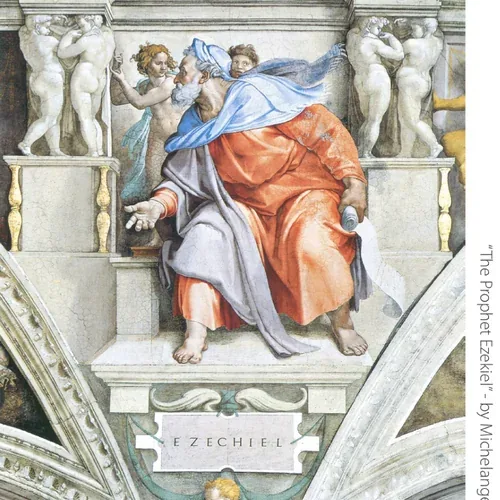
“Prophet in the Abrahamic religions”
Ezekiel, also spelled Ezechiel, was an Israelite priest. The Book of Ezekiel, relating his visions and acts, is named after him.
Following the 597 and 586 BCE deportations to Babylon, the traumatized Judean exiles believed God’s presence had been defeated or permanently confined to the burning ruins of Jerusalem.
By the Chebar River in Babylon, Ezekiel witnessed the glory of the divine chariot (*Merkavah*) moving freely beyond the borders of Judea, declared individual moral responsibility, envisioned the resurrection of the nation in the Valley of Dry Bones, and drafted detailed blueprints for the restored Temple.
Established the foundation for Jewish mysticism (*Ma’aseh Merkavah*), proved that the Divine Presence accompanies Israel into exile, and inspired the national and spiritual resurrection of the Jewish people.
Tracing the downstream transmission from Ezekiel’s initial intervention through immediate adapters, institutionalization, and enduring consequences in human history.
By the Chebar River in Babylon, Ezekiel witnessed the glory of the divine chariot (*Merkavah*) moving freely beyond the borders of Judea, declared individual moral responsibility, envisioned the resurrection of the nation in the Valley of Dry Bones, and drafted detailed blueprints for the restored Temple.
Rulings, codes, and hermeneutic principles incorporated into yeshiva curricula and communal adjudication.
Commentaries, codes, and responsa accepted as authoritative standards by Diaspora communities.
Theological response to the destruction of the First Temple and exile.
Under editorial review.
Without Ezekiel’s dramatic vision of the Divine Chariot and the Valley of Dry Bones, the exiles would have surrendered to despair and existential oblivion by the rivers of Babylon.
How many people, institutions, societies, or disciplines were affected?
Ezekiel: Examines Ezekiel’s priestly worldview and his transformative doctrine that God’s mobility and holiness extend into foreign lands.
[Ezekiel 37:1–14] The Vision of the Valley of Dry Bones: the breath of God infuses life into the slain, symbolizing the return and national revival of Israel.
The Vision of the Valley of Dry Bones: the breath of God infuses life into the slain, symbolizing the return and national revival of Israel.
Examines Ezekiel’s priestly worldview and his transformative doctrine that God’s mobility and holiness extend into foreign lands.
Integrated into daily liturgy, lifecycle rites, and Jewish constitutional identity worldwide.
Established the foundation for Jewish mysticism (*Ma’aseh Merkavah*), proved that the Divine Presence accompanies Israel into exile, and inspired the national and spiritual resurrection of the Jewish people.
How fundamentally did they alter the structural state of the field or world?
Did the consequences endure decades, centuries, or millennia?
Did they introduce a genuinely new paradigm vs. incremental refinement?
Would this change have happened without this specific individual?
How crucial to Jewish civilization, Torah, ethics, or Israel?
Comprehensive multi-dimensional evaluation of civilizational reach, conceptual depth, duration of legacy, and historical causation across Jewish and world history.