1K
Loading Reference Work…
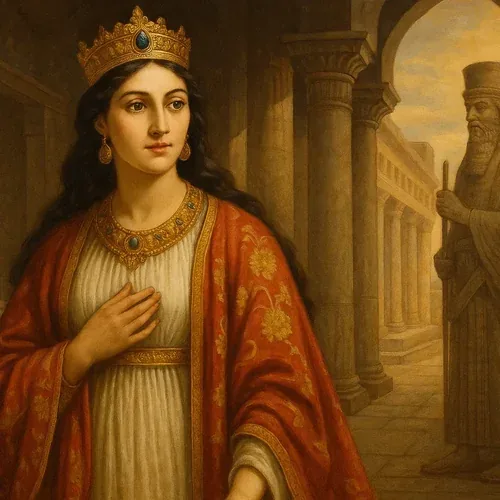
“Biblical Jewish queen of Persia and Medes”
Esther, originally Hadassah, is the eponymous heroine of the Book of Esther in the Hebrew Bible.
The Jewish population scattered across the 127 provinces of the Achaemenid Persian Empire faced an imminent, state-sanctioned decree of total extermination engineered by the grand vizier Haman.
Esther concealed her identity until the decisive moment, called a three-day total fast across Susa, risked her life by approaching the Persian king unsummoned ("If I perish, I perish"), and exposed Haman’s genocidal conspiracy at a private banquet.
Rescued the entire Jewish people from annihilation, established the joyous annual holiday of Purim with its mandates of mutual gift-giving and charity to the poor, and created the preeminent biblical paradigm of diaspora heroism.
Tracing the downstream transmission from Esther’s initial intervention through immediate adapters, institutionalization, and enduring consequences in human history.
Esther concealed her identity until the decisive moment, called a three-day total fast across Susa, risked her life by approaching the Persian king unsummoned ("If I perish, I perish"), and exposed Haman’s genocidal conspiracy at a private banquet.
Rulings, codes, and hermeneutic principles incorporated into yeshiva curricula and communal adjudication.
Commentaries, codes, and responsa accepted as authoritative standards by Diaspora communities.
Without Esther’s shrewd political courage, Haman’s empire-wide pogrom would have wiped out Jewish life across the Persian realm, extinguishing the communities that maintained the biblical heritage.
How many people, institutions, societies, or disciplines were affected?
Esther: Explores the sophisticated Persian court farce and the theological significance of divine hiddenness (*hester panim*) operating through human political acumen.
[Esther 4:13–16] Mordecai’s challenge and Esther’s resolution: "Who knows if you have not come to royal status for such a time as this?" and "If I perish, I perish."
[Esther 9:20–28] The establishment of the festival of Purim as days of feasting, gladness, sending portions to one another, and gifts to the poor.
Mordecai’s challenge and Esther’s resolution: "Who knows if you have not come to royal status for such a time as this?" and "If I perish, I perish."
The establishment of the festival of Purim as days of feasting, gladness, sending portions to one another, and gifts to the poor.
Explores the sophisticated Persian court farce and the theological significance of divine hiddenness (*hester panim*) operating through human political acumen.
Integrated into daily liturgy, lifecycle rites, and Jewish constitutional identity worldwide.
Rescued the entire Jewish people from annihilation, established the joyous annual holiday of Purim with its mandates of mutual gift-giving and charity to the poor, and created the preeminent biblical paradigm of diaspora heroism.
How fundamentally did they alter the structural state of the field or world?
Did the consequences endure decades, centuries, or millennia?
Did they introduce a genuinely new paradigm vs. incremental refinement?
Would this change have happened without this specific individual?
How crucial to Jewish civilization, Torah, ethics, or Israel?
Comprehensive multi-dimensional evaluation of civilizational reach, conceptual depth, duration of legacy, and historical causation across Jewish and world history.