1K
Loading Reference Work…
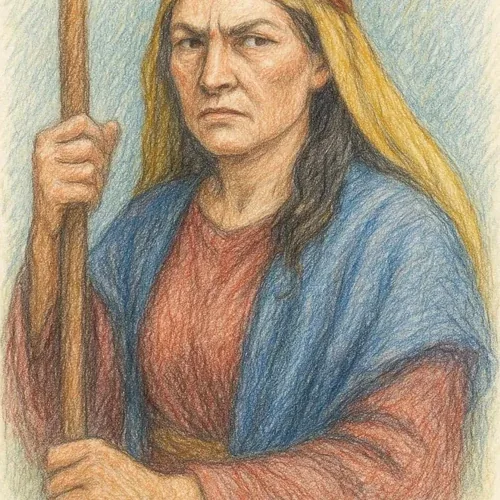
“Prophetess in the Bible”
According to the Book of Judges, Deborah was a prophetess of Judaism, the fourth Judge of pre-monarchic Israel and the only female judge mentioned in the Hebrew Bible. Many scholars contend that the phrase, "a woman of Lappidoth", as translated from biblical Hebrew in Judges 4:4 denotes her marital status as the wife of Lapidoth. Alternatively, "lappid" translates as "torch" or "lightning", therefore the phrase, "woman of Lappidoth" could be referencing Deborah as a "fiery woman". Deborah told Barak, an Israelite general from Kedesh in Naphtali, that God commanded him to lead an attack against the forces of Jabin king of Canaan and his military commander Sisera ; the entire narrative is recounted in chapter 4.
Northern Israel suffered twenty years of brutal oppression under Jabin, King of Hazor, whose general Sisera terrorized the valleys with nine hundred iron chariots, rendering highways deserted.
Deborah judged Israel beneath her palm tree, summoned Barak to lead the tribal forces, orchestrated military strategy at Mount Tabor where torrential rains bogged down Sisera’s iron chariots, and composed the archaic, triumphant Song of Deborah.
Secured forty years of peace in the land and established an enduring biblical paradigm of a female judge, prophet, and national commander holding supreme judicial and military authority.
Deborah holds court under the palm tree, commands Barak to assemble troops, and leads Israel to victory.
Tracing the downstream transmission from Deborah’s initial intervention through immediate adapters, institutionalization, and enduring consequences in human history.
Deborah judged Israel beneath her palm tree, summoned Barak to lead the tribal forces, orchestrated military strategy at Mount Tabor where torrential rains bogged down Sisera’s iron chariots, and composed the archaic, triumphant Song of Deborah.
Rulings, codes, and hermeneutic principles incorporated into yeshiva curricula and communal adjudication.
Commentaries, codes, and responsa accepted as authoritative standards by Diaspora communities.
Without Deborah’s prophetic fire and strategic summons, Sisera would have permanently severed the northern and southern tribes, extinguishing Israel’s foothold in Galilee.
How many people, institutions, societies, or disciplines were affected?
Deborah: Highlights Judges 5 as a pristine masterpiece of ancient West Semitic poetry and analyzes Deborah’s unique authority as "a mother in Israel."
[Judges 4:4–16] Deborah holds court under the palm tree, commands Barak to assemble troops, and leads Israel to victory.
[Judges 5:1–31] The Song of Deborah: one of the oldest poetic texts in the Hebrew Bible celebrating divine victory and tribal solidarity.
The Song of Deborah: one of the oldest poetic texts in the Hebrew Bible celebrating divine victory and tribal solidarity.
Highlights Judges 5 as a pristine masterpiece of ancient West Semitic poetry and analyzes Deborah’s unique authority as "a mother in Israel."
Integrated into daily liturgy, lifecycle rites, and Jewish constitutional identity worldwide.
Secured forty years of peace in the land and established an enduring biblical paradigm of a female judge, prophet, and national commander holding supreme judicial and military authority.
How fundamentally did they alter the structural state of the field or world?
Did the consequences endure decades, centuries, or millennia?
Did they introduce a genuinely new paradigm vs. incremental refinement?
Would this change have happened without this specific individual?
How crucial to Jewish civilization, Torah, ethics, or Israel?
Comprehensive multi-dimensional evaluation of civilizational reach, conceptual depth, duration of legacy, and historical causation across Jewish and world history.