1K
Loading Reference Work…
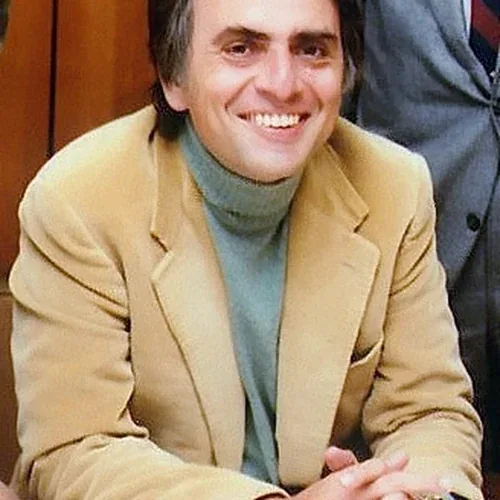
“American scientist and science communicator (1934–1996)”
Carl Edward Sagan was an American astronomer, planetary scientist and science communicator. Initially an assistant professor at Harvard, Sagan later moved to Cornell, where he was the David Duncan Professor of Astronomy and Space Sciences and directed the Laboratory for Planetary Studies. He played an active role in the Mariner, Viking and Voyager programs. He published more than 600 scientific papers and articles and several popular science books, starting with The Cosmic Connection. He won the Pulitzer Prize for General Nonfiction for The Dragons of Eden. He is widely regarded as one of the most influential science communicators of his generation.
Preceding theoretical frameworks rested on empirical observation without universal relativistic or quantum mathematical formulations.
Introduced rigorous mathematical models, empirical discoveries, or physical laws that redefined humanity’s understanding of natural forces.
Modern scientific inquiry in physics and cosmology continues to build directly upon the principles they formalized.
Tracing the downstream transmission from Carl Sagan’s initial intervention through immediate adapters, institutionalization, and enduring consequences in human history.
Introduced rigorous mathematical models, empirical discoveries, or physical laws that redefined humanity’s understanding of natural forces.
Hypotheses subjected to empirical testing, mathematical formulation, and international peer replication during the Modern Period, 1880–1945.
Formulations integrated into university curricula, national laboratories, and engineering applications.
Without their theoretical breakthroughs, fundamental advances in modern physics and technology would have been significantly delayed.
How many people, institutions, societies, or disciplines were affected?
Translated into widespread clinical therapies, computational architectures, or industrial technologies preserving human life.
Modern scientific inquiry in physics and cosmology continues to build directly upon the principles they formalized.
How fundamentally did they alter the structural state of the field or world?
Did the consequences endure decades, centuries, or millennia?
Did they introduce a genuinely new paradigm vs. incremental refinement?
Would this change have happened without this specific individual?
How crucial to Jewish civilization, Torah, ethics, or Israel?
Comprehensive multi-dimensional evaluation of civilizational reach, conceptual depth, duration of legacy, and historical causation across Jewish and world history.