1K
Loading Reference Work…
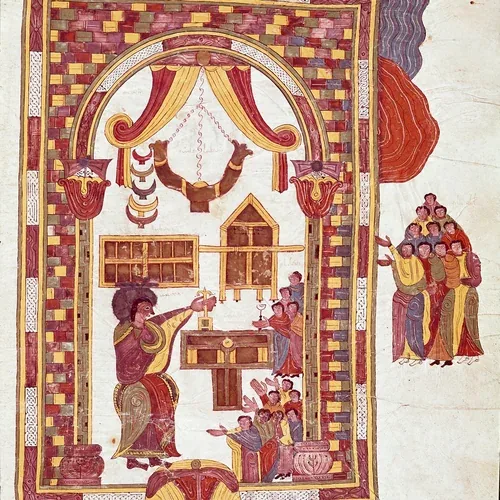
“Prophet in the Abrahamic faiths”
According to the Old Testament of the Bible, Aaron was an Israelite prophet, high priest, and the elder brother of Moses. Information about Aaron comes exclusively from religious texts, such as the Hebrew Bible, the New Testament, and the Quran.
Sacred ritual was ad-hoc and clan-based, with heads of households performing sacrifices without structured holiness standards, communal atonement liturgies, or institutional separation of prophetic and priestly powers.
Aaron was consecrated as Israel’s first High Priest (*Kohen Gadol*), wearing the breastplate bearing the names of the twelve tribes upon his heart, instituted the Yom Kippur Day of Atonement liturgy, and modeled the rabbinic ideal of "loving peace and pursuing peace."
Established the Aaronic priesthood (*Kehunah*) and Levitical sanctuary system that sustained Jewish sacrificial worship through the First and Second Temples, and authored the enduring Priestly Blessing (*Birkat Kohanim*).
Tracing the downstream transmission from Aaron’s initial intervention through immediate adapters, institutionalization, and enduring consequences in human history.
Aaron was consecrated as Israel’s first High Priest (*Kohen Gadol*), wearing the breastplate bearing the names of the twelve tribes upon his heart, instituted the Yom Kippur Day of Atonement liturgy, and modeled the rabbinic ideal of "loving peace and pursuing peace."
Rulings, codes, and hermeneutic principles incorporated into yeshiva curricula and communal adjudication.
Commentaries, codes, and responsa accepted as authoritative standards by Diaspora communities.
Co-leadership of the Exodus: prophet and high priest.
Under editorial review.
Without Aaron, Israel would have lacked a permanent sacramental and ritual institution to mediate communal atonement and maintain sacred space during the forty years of wilderness wandering and the subsequent Temple eras.
How many people, institutions, societies, or disciplines were affected?
Aaron: Elucidates the theology of the Aaronic priesthood, the sacred geography of the sanctuary, and the mechanics of communal expiation.
[Numbers 6:22–27] The Priestly Blessing (*Birkat Kohanim*): "The Lord bless you and protect you; the Lord make His face shine upon you and be gracious to you."
[Leviticus 16:1–34] The Yom Kippur sacrificial order: purification of the sanctuary and national atonement.
The Priestly Blessing (*Birkat Kohanim*): "The Lord bless you and protect you; the Lord make His face shine upon you and be gracious to you."
The Yom Kippur sacrificial order: purification of the sanctuary and national atonement.
Elucidates the theology of the Aaronic priesthood, the sacred geography of the sanctuary, and the mechanics of communal expiation.
Integrated into daily liturgy, lifecycle rites, and Jewish constitutional identity worldwide.
Established the Aaronic priesthood (*Kehunah*) and Levitical sanctuary system that sustained Jewish sacrificial worship through the First and Second Temples, and authored the enduring Priestly Blessing (*Birkat Kohanim*).
How fundamentally did they alter the structural state of the field or world?
Did the consequences endure decades, centuries, or millennia?
Did they introduce a genuinely new paradigm vs. incremental refinement?
Would this change have happened without this specific individual?
How crucial to Jewish civilization, Torah, ethics, or Israel?
Comprehensive multi-dimensional evaluation of civilizational reach, conceptual depth, duration of legacy, and historical causation across Jewish and world history.